
what is abstract photography
Abstract photography challenges the traditional idea that photographs must depict clearly identifiable subjects. Instead, it treats the image itself, and the process of creating it as the main focus. To achieve this, abstract photographs often highlight the internal structure of the image, reveal elements that are normally unseen, or emphasize pure visual qualities such as form, light, and pattern.
The production of abstract images has frequently been used as a form of visual investigation, helping artists and photographers better understand how images work and what they can communicate. Early examples can be traced back to the 1830s, when William Henry Fox Talbot produced contact prints of plants. Later, in the late nineteenth century, Étienne-Jules Marey created chronophotographs that explored movement through sequences of images.
However, Alvin Langdon Coburn is widely regarded as the father of abstract photography. In his 1916 essay ‘The Future of Pictorial Photography‘, he introduced the term and proposed exhibiting photographs that focus on the forms and structures within the image itself rather than on references to objects in the outside world. He called his own abstract experiments “Vortographs,” which were inspired by the artistic movement known as Vorticism in painting.
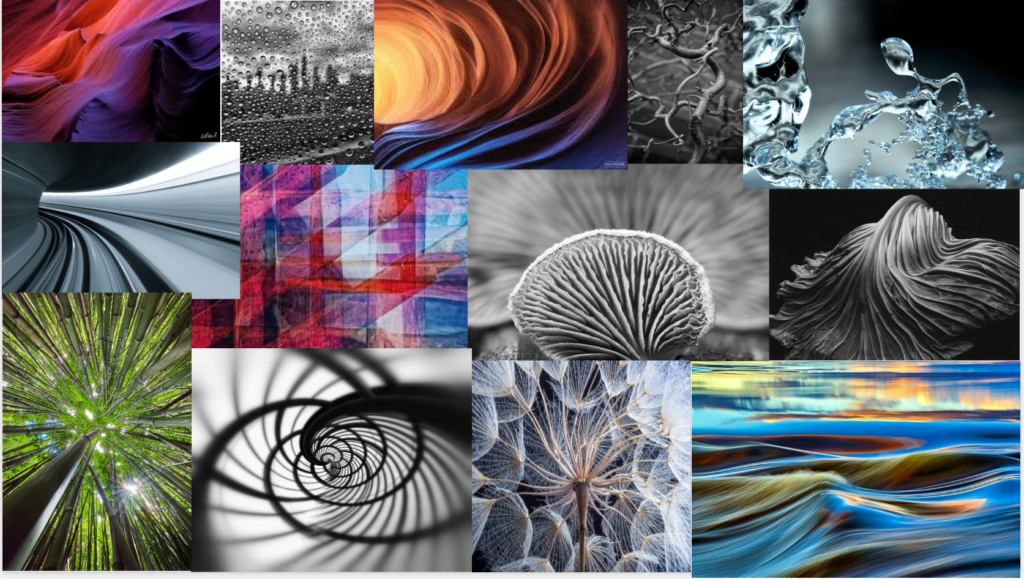
Moodboard
facts about abstract photography
Key Facts About Abstract Photography:
- Purpose: The goal is to create a feeling or impression through visual elements rather than documenting a scene.
- Origins: Early examples appeared in the 1840s; Anna Atkins used cyanotypes for botanical studies, while John William Draper used spectroscopes to create abstract scientific images.
- Core Elements: Key composition elements include patterns, repetition, texture, high-contrast light, and unconventional, close-up perspectives.
- Techniques: Common methods involve intentional camera movement (ICM), long exposure, macro photography, and light painting.
- Famous Practitioners: Aaron Siskind is known for using photography to focus on lines and textures similar to abstract expressionist paintings.
- Subject Matter: Anything can be a subject, particularly natural patterns, architectural details, or intentional reflections.
- Types: It includes cameraless photography (like photograms) and heavily edited digital images.